

Learning from Longonot
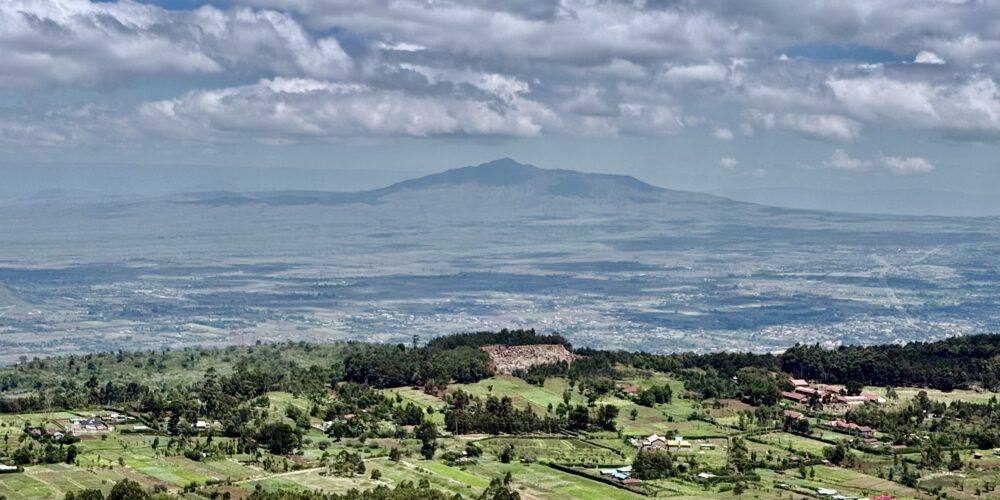
On the trail up Mount Longonot, dust lifts in small golden sighs beneath your boots. Acacia shadows stretch and shrink with the moving sun. Somewhere below, Lake Naivasha glints like a dropped coin.
Then you reach the rim and find yourself staring into a vast, silent bowl, green and deep. You sense that this old volcano has a story to tell.
Over hundreds of thousands of years, molten rock welled up from deep fractures in the earth’s crust, cooling and hardening layer by layer to form a broad volcanic cone. Each eruption added another skin of dark stone, another contour to the rising mass. Ash settled, rains carved, grasses returned. From afar, it would have seemed the mountain was simply growing into itself, patient and assured.
Then, tens of thousands of years ago, Longonot blew its own top off. Pressure built beneath the summit until the old peak could no longer contain it. A violent series of eruptions tore open the top, blasting ash and gas skyward and draining the magma chamber below. With its support gone, the summit collapsed inward, leaving the great crater that now defines the mountain.
What appears serene is, in truth, the aftermath of upheaval.
Now let’s get to the real point of today’s Signal. We’re not really talking lava, we’re talking leadership.
It is tempting to think that human institutions are different. We build them carefully, name them grandly, and assume they will endure by sheer force of reputation. Years of success lay down their own layers of habit and hierarchy. Titles harden. Norms settle into ritual. From a distance, everything looks settled, even timeless.
Yet pressure builds here too. Markets shift. Generations change their expectations. Technologies redraw the terrain. What once held firm can begin, quietly, to strain at the seams. The lesson from landscapes like Longonot is not about drama or destruction. It is about renewal. Systems that find ways to release pressure, refresh their leadership, and rethink how they are governed are the ones that remain alive to their times.
At some point, your organization, your nation, will also need to blow its top.
To be clear upfront: I am not advocating for apocalyptic eruptions. Institutions need careful pruning or controlled demolitions from time to time. Sometimes, they just need a change of air at the top floor.
The problem with renewal, whether explosive or evolutive, is that it is not polite.
Meaningful institutional refreshment often feels disruptive to insiders. Long-serving leaders experience succession as loss. Boards experience reform as critique. Founders experience dilution as betrayal. Yet systems that never change their summit eventually become museums of former excellence. A periodic “blowing of the top” can prevent a far worse fate: slow erosion into mediocrity.
Leadership transition need not be framed as failure or scandal. It can be framed as ecology, as rhythm. Institutions that consciously design renewal rituals are like landscapes that release pressure before the big eruption. The point is not destruction, but re-oxygenation.
Volcanoes erupt because physics leaves them no choice. Human systems have agency. Wise boards plan succession before desperation. Mature founders design their own obsolescence with grace. States reform constitutions before legitimacy fractures. Renewal becomes an act of foresight, not panic.
Sadly, most human constructs seem unable to pull this off. They freeze and fossilize at the top, repeating the same old adages and tired wisdoms until, seemingly suddenly, their future is gone. Then the top is blown off more forcefully, by the market, by technology, by the customer, by the voter. Or by revolutionaries.
The lesson of Longonot? Design exits before they are forced upon you. Rotate authority before it fossilizes. Refresh governance norms before they become theatre. Let institutions breathe new altitude air.
Mountains remain alive by reshaping their own peaks.
Institutions must learn the same discipline.
When renewal is delayed, the summit does not age gracefully. It erupts.
THE SIGNAL IN THE NOISE
If leaders do not make space at the top, pressure will make it for them.

Buy Sunny Bindra's new book
The X in CX
here »




Popular Posts
 The mathematics of a good lifeSeptember 27, 2026
 CX that’s all tech and no soulSeptember 20, 2026
 When nothing goes wrong, but you’re still in troubleOctober 4, 2026
 Must everything have a purpose?October 11, 2026