

Why was this World Cup a sea of sameness?
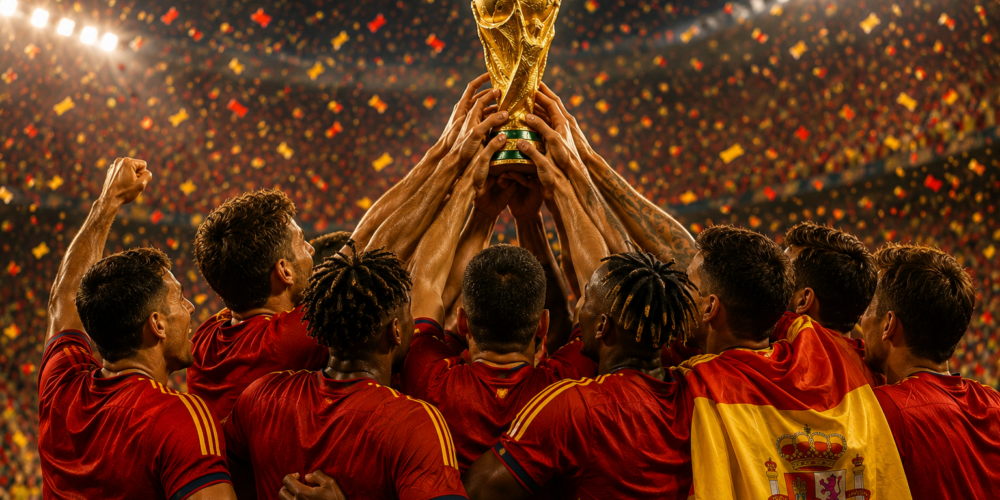
Strip away the shirts, flags and national anthems from this World Cup, and you might have struggled to identify who is playing.
Nearly every team seemed to line up in some version of the same tactical playbook. Four at the back, three when in possession. A holding midfielder dropping deep. Full-backs pushing forward or “inverting” into midfield. Wingers cutting inside. A lone striker, or none. Everyone pressing, counter-pressing, building from the back, trying to overload the half-spaces.
The World Cup once offered more than a competition between nations. It was a collision between footballing civilizations.
Brazil arrived with improvisation, flamboyance, and sheer joy. Italy brought the locked doors of catenaccio. The Netherlands gave us Total Football, with players floating between positions like ballet dancers. Germany appeared with power and remorseless organization. Argentina carried streetcraft and cunning. England launched the ball forward and hoped a large forehead would meet it. The Africans came with swagger, daring and the exhilarating sense that anything might happen.
Some of those descriptions were caricatures, certainly. National styles were never as pure as memory paints them.
But the differences were real enough. Teams brought their histories and cultures with them. You could often tell who was playing without looking at the scoreboard. Football had strong accents.
Today’s players spend most of their professional lives far from their national teams. At this World Cup, a huge number of squad members play their club football in England, Germany, France, and Spain. They are coached inside the same global industry, watching the same footage, absorbing the same analytics and learning the same fashionable systems. Tactical innovations are identified, named, diagrammed and uploaded before the innovator has finished celebrating.
Football has developed a tactical Esperanto.
There are benefits. The general standard is higher; smaller nations are better organized and harder to overwhelm. At this tournament, teams from outside the traditional elite have competed impressively, and nine of Africa’s ten representatives reached the knockout stage.
Convergence raises the floor. But it also lowers the ceiling.
When everyone studies the same evidence and copies the same winners, everyone begins to make the same choices. The game becomes more efficient, more technically sophisticated and more difficult to play badly.
It also becomes less surprising.
Spain won this World Cup while remaining unmistakably Spain. Whatever the opposition, they trusted their philosophy and their patterns of play, adapting without abandoning themselves. They were the standout team because their football had clarity, consistency and identity.
Flattening of identity is not confined to football.
Look at business strategy. Leaders travel to the same conferences, hire people with the same MBAs, commission advice from the same firms and study the same celebrated companies. They emerge talking about ecosystems, agility, transformation, customer centricity and artificial intelligence.
Then they produce strategies almost indistinguishable from those of their competitors. Different logos, identical thinking.
Benchmarking teaches organizations to look sideways. Best practice tells them what successful institutions already do. Industry research identifies the accepted priorities. Consultants provide frameworks polished by repeated use.
All of this is useful, until it becomes a substitute for thought.
Because strategy is not the art of discovering what everyone else has already discovered. It is the art of making a choice others have not made. Of understanding your particular circumstances, capabilities and character, and creating an approach that could only have come from you.
Society is experiencing the same flattening. Travel across continents and encounter the same coffee shops, apartment interiors, shopping centres, music, clothing and vocabulary. Open social media and watch millions of people rehearsing versions of the same dances, opinions, holidays, meals and faces.
The world has never offered us more variety. Yet we increasingly choose from the same small menu.
Perhaps that is why we still treasure the rare footballer who ignores the system for a moment. The one who tries the unnecessary pass, the outrageous dribble, the shot nobody has authorized. For a few seconds, the carefully programmed machine flickers, and a human being appears.
The crowd rises because it recognizes something it has been missing; a Maradona, a Cruyff, a Ronaldinho, a Weah, a Zidane. Footballers who could only ever have played as themselves.
Not merely skill. Distinctiveness.
Every team must master the modern game. Every organization must meet the prevailing standards. Every person must learn enough of society’s rules to function within it.
But mastery should be the beginning, not the destination.
Learn the formation. Understand the system. Study the winners.
Then recover your accent. Be gloriously, peculiarly different.
THE SIGNAL IN THE NOISE
Copying raises competence. Difference creates advantage.
Buy Sunny Bindra's new book
The X in CX
here »




Popular Posts
 The mathematics of a good lifeSeptember 27, 2026
 CX that’s all tech and no soulSeptember 20, 2026
 When nothing goes wrong, but you’re still in troubleOctober 4, 2026
 We’ll all have to think againSeptember 13, 2026