

The brand in the background
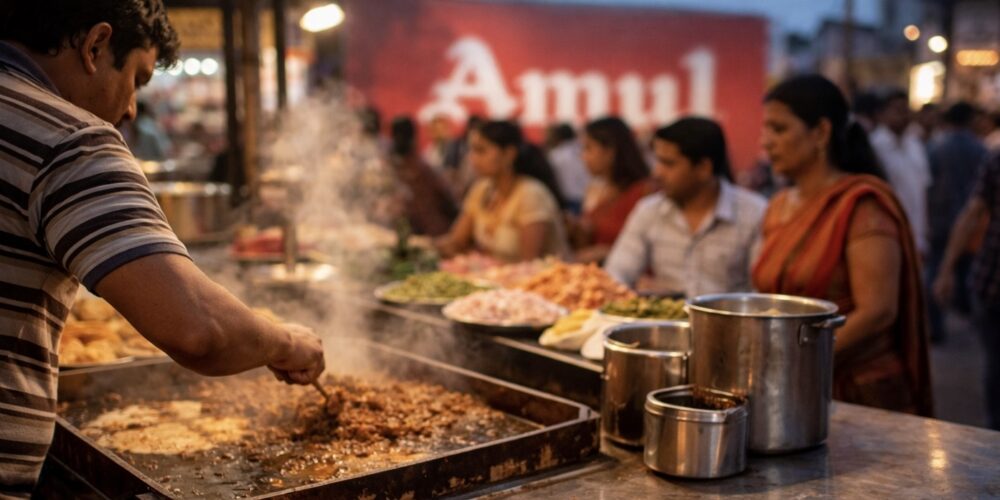
You can’t spend time in India, in person or online, without seeing it. It is everywhere.
Amul Butter rules. With roughly 85% of the Indian butter market, it is not merely a butter brand. For hundreds of millions, it is the butter. Browse the endless street-food videos on YouTube and you’ll hear vendors proudly tell the camera what they use: Amul Butter.
Amul’s achievement is bigger than market share. Plenty of brands lead categories. Fewer become part of the country’s muscle memory. Amul Butter crossed that line long ago. It sits not just in fridges and on shop shelves, but in routines, food habits, café counters, railway snacks, and the visual language of Indian street food. It is bought, used, shown, and named with the casual certainty reserved for things people trust without much thought.
Amul is widely regarded as India’s top food brand, and Brand Finance ranked it the world’s strongest food brand in 2024, a measure not of sheer size but of the depth of its connection to its audience.
That is what makes Amul so interesting. Its power does not come from aspiration or cool. It comes from embeddedness. In a business world obsessed with novelty, Amul reminds us that the strongest brands are often the ones that become ordinary in the richest possible sense. Not boring or invisible. Just woven so deeply into everyday rhythms that they stop feeling like a choice at all.
But how did Amul pull this off?
Part of the answer lies in where Amul came from and what it built. This was not a brand dreamed up in an ad agency and then pushed onto a market. It emerged from a farmers’ cooperative movement that began in 1946, and the structure still matters. Millions of milk producers feed into the system, and the federation markets the products at national scale. That gives Amul something many brands spend decades chasing: deep roots, huge supply, and a story of legitimacy that is not merely decorative.
Then there is the more visible part. Amul did not build this position through scarcity, mystique, or premium posturing. It got there by being available, affordable, and relentlessly present. The famous “Amul Girl” campaign has been running since 1966, giving the brand a rare mix of consistency and cultural wit, while the wider business built enormous reach through village societies, district unions, and nationwide distribution. In simple terms, Amul kept showing up, kept staying relevant, and kept making itself easy to buy. That is less glamorous than modern brand theatre, but far more formidable.
That is the real lesson from Amul. The highest form of brand success is not awareness. It is residency. Plenty of brands are recognised on sight, recalled in surveys, even admired in passing. Far fewer take up residence in the everyday lives of a people. They are there in habits, rituals, memories, shortcuts, and assumptions. They stop being something consumers evaluate and start becoming something they reach for almost automatically.
That kind of position is usually built not through strategic theatre, but through daily usefulness. Business culture loves fireworks. We celebrate reinvention, disruption, splashy campaigns, and the latest performance of cleverness. But many of the strongest commercial fortresses are built more quietly. They are like plumbing. You do not stand around admiring them, but you notice the instant they fail. A product that is affordable, available, trusted, and woven into routine can become far stronger than one that merely makes noise.
And once a brand moves beyond use and into culture, the thing compounds. It starts appearing in jokes, in childhood memories, in shared references, in the language of ordinary life. It acquires a second life beyond the product itself. That is when commercial strength becomes something more durable. Competitors can copy features, packaging, even price points. It is much harder to copy cultural presence.
So the Signal here is simple. Many businesses chase attention. The smarter ambition may be deeper than that. Do not ask only whether people know your brand. Ask whether it has earned a place in the rhythms of their lives. Because in the end, the strongest brands are not always the loudest or the most dazzling. They are the ones people would actually miss if they disappeared.
THE SIGNAL IN THE NOISE
Some brands win shelf space. A few win habit. The rare ones win culture.

Buy Sunny Bindra's new book
The X in CX
here »




Popular Posts
 The mathematics of a good lifeSeptember 27, 2026
 CX that’s all tech and no soulSeptember 20, 2026
 When nothing goes wrong, but you’re still in troubleOctober 4, 2026
 We’ll all have to think againSeptember 13, 2026