

When digital eats the experience
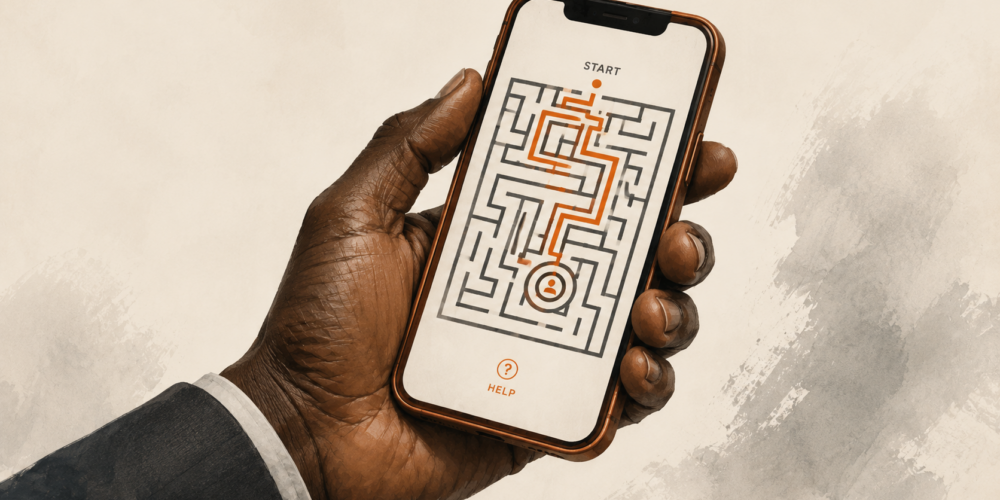
Since the COVID pandemic, many restaurants exclusively use digital menus. You scan a QR code from your table, get a menu on your phone, pick your dishes, even pay for them right there.
Your first meaningful contact with a human being might be when the dishes are brought to your table.
It’s quick, it generally works, it’s cheaper and more efficient than printing expensive menus and employing more young people to explain them.
And yet.
If the eatery in question is a fast-food chain frequented mostly by youngsters, I get it. And so do they. They live their lives on their devices, so using them for yet another task comes naturally. For that setting, digital may well improve the experience. Speed matters. Low friction matters. Minimal conversation may even be preferred.
But what about finer-dining establishments? The ones patronized by older customers, business diners, families marking occasions, people who have come out for an evening rather than a refuelling stop?
Why would you force those customers into a tiny glowing tunnel? Why make them peer at a screen, pinch and zoom, wait for a page to load, deal with poor Wi-Fi, scroll through badly formatted categories, and then pretend this is progress?
Why you do this is a mystery to me. For a higher-end restaurant, the people and the artefacts are part of what customers are paying for. A well-trained server is not a cost item. A beautifully presented menu is a mood enhancer. The small conversation at the table, the explanation of specials, the sense of being hosted, the gentle steering toward the right dish or wine: these are not frills. They are the product.
Why would you cut off a key part of the customer experience to save the wrong pennies?
A popular restaurant is not merely a food-delivery mechanism with chairs. Many behave as though it is. They remove the host, shrink the menu, flatten the encounter, and call it innovation. They save a little on paper and wages, and lose a little of the soul of the place. This is not digital transformation. It is degraded hospitality.
This is happening everywhere. Businesses are going digital as though obeying a compulsory edict carved into stone by the gods of efficiency. We must have apps. We must have AI. We must be touchless. We must remove humans wherever possible. Why?
Because we’ll get left behind. Because customers expect it. Because it saves money. Because the consultants said so, and the consultants had a very slick deck.
Take airlines. Booking a ticket online should be easy, and often it is. But try doing anything slightly unusual. Change a name. Add a child. Correct a date. Use a voucher. Book across partner airlines. Manage a cancelled flight. Request a refund. Suddenly the smooth digital highway becomes a goat track in the rain.
You now need to know which fields trigger errors, which digits to omit from your phone number, which browser behaves itself, which cookies are causing the system to sulk, which payment card will mysteriously fail at the final step. You may find yourself trapped between an app that will not work and a chatbot that will not understand. The whole thing becomes a digital dojo, and you’d better be a trained ninja.
Would it be better if a well-trained human handled the problem? Often, yes. But many of those people have been removed, hidden, outsourced, or instructed not to answer the phone unless the customer first survives fourteen layers of automated fencing. Humans are expensive, temperamental, needy. Pixels are obedient. Pixels do not ask for lunch breaks or get moody on you.
Unfortunately, pixels also do not notice distress. They do not hear hesitation. They do not sense urgency.
OK, end of rant. The point is this. Digital tools are excellent when the task is simple, frequent, predictable, and low-emotion. They are poor when the customer is anxious, confused, angry, embarrassed, under pressure, or dealing with an exception. The moment a customer’s problem becomes human, a purely digital system often becomes a wall.
This is where many businesses get it wrong. They don’t ask: what is the customer trying to feel here? They only ask: what cost can we remove?
Sometimes the customer wants speed. Give them digital.
Sometimes the customer wants privacy. Give them digital.
Sometimes the customer wants control, comparison, tracking, simplicity, convenience. Give them digital, and make it clean and beautiful.
But sometimes the customer wants reassurance. Sometimes they want rescue. Sometimes they want to feel seen. Sometimes they want the quiet competence of another human being taking responsibility. In those moments, the app should not be the whole experience. It should be the servant of the experience.
Digital should do the dull work. Let it remember, route, calculate, confirm, track, alert, store, compare, and repeat. Let it remove waiting, duplication, paperwork, and pointless phone calls. Wonderful. Bring it on.
But don’t let digital take over the work that depends on judgment, empathy, taste, persuasion, trust, and recovery. Don’t let it replace the conversation that sells the wine, the reassurance that calms the traveller, the explanation that helps the patient, the advice that guides the client, the apology that rescues the relationship.
Here is the test.
When the customer already knows what they want, digital can lead.
When the customer does not know, is worried, is spending serious money, is marking an important moment, is dealing with risk, or needs an exception handled, humans should lead.
The best customer experiences will not be proudly digital or proudly human. They will be intelligently blended. The machine will do what machines do best: speed, memory, consistency, scale. The human will do what humans do best: notice, explain, adapt, reassure, delight, recover.
Remove the human where the customer needs humanity, and you do not improve the experience. You hollow it out.
THE SIGNAL IN THE NOISE
Digitize the boring. Humanize the important.
Buy Sunny Bindra's new book
The X in CX
here »



Popular Posts
 The mathematics of a good lifeSeptember 27, 2026
 CX that’s all tech and no soulSeptember 20, 2026
 When nothing goes wrong, but you’re still in troubleOctober 4, 2026
 Must everything have a purpose?October 11, 2026