

Strategy lessons from the dodo
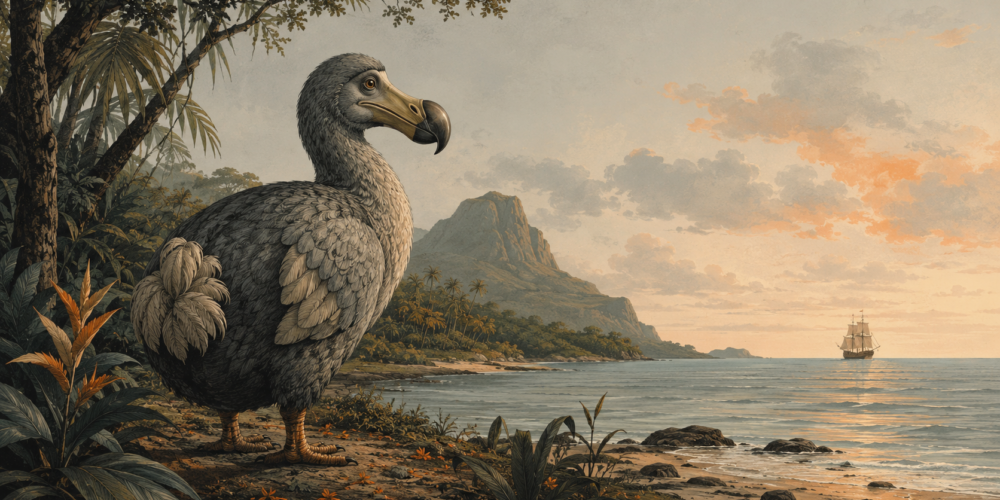
A recent assignment in Mauritius brought a strange bird back to mind. It is on the country’s coat of arms, and all over popular culture: public imagery, tourist shops, even stamps. The dodo.
The dodo is extinct, though. Mauritius has turned the dodo into a national ghost with a commercial and emblematic afterlife.
Raphus cucullatus lived solely on Mauritius, minding its own business, eating fruit, nesting on the ground, bothering no one. It had no reason to fly. Its island had given it no serious land predators. So over time, flight became unnecessary. Wings shrank. Legs strengthened. Life settled into a safe rhythm.
Then the world arrived by ship.
Sailors came first. Then came settlement. Then came the animals humans carried with them: dogs, cats, pigs, rats. The dodo could perhaps survive some hunting. What it could not survive was the sudden arrival of an entirely class of enemy.
Its eggs were on the ground. Its instincts were tuned to a gentler island. Its defences were built for a world that no longer existed.
Within decades, it was gone.
The dodo, please note, was not stupid. It was well-adapted for its environment. The problem is that adaptation is not the same as readiness. You can be perfectly designed for yesterday and hopelessly exposed tomorrow.
Many organizations should pause over that sentence. Because a company can become flightless too.
Your company may not be stupid.
Your strategy may not be foolish.
Your people may not be lazy.
Your systems may not be broken.
They may simply be tuned to an island that no longer exists.
What has your organization grown used to? A protected market, a loyal customer base, a friendly regulator, a powerful brand, a comfortable margin? You might stop exercising certain muscles because you no longer need them. You can forget how to move fast, listen hard, experiment cheaply, challenge yourself honestly.
And for a while, nothing bad happens. The island feels safe. Then something arrives. A new technology. A new competitor. A new customer expectation. A new cost structure. A new generation of employees. A new platform that changes the rules of distribution. A new scandal that destroys trust. A new regulation that removes old shelter.
Leaders often look for the obvious predator. Who is attacking us? Who is taking our market? Who is undercutting our price?
But the dodo story tells us to look more carefully. The real danger may not be the sailor. It may be the rats in the cargo hold.
The hidden threats are often the ones that do the lasting damage. Not just AI, but what AI does to customer patience. Not just digital channels, but what they do to human relationships. Not just cost-cutting, but what it does to memory, judgement and care. Not just a new competitor, but the new standards customers adopt after meeting that competitor.
Extinction rarely announces itself with a trumpet. More often, it starts with eggs quietly disappearing from the nest.
Are you very successful? Now ask this: What kind of world is our success built for? If the answer is “the old one,” the wings may already be shrinking. The dodo’s lesson is not that the weak perish. It is sharper than that. The well-adapted perish too, when the island changes and they do not.
And so, we must all look for the muscles that have gone soft because success made them unnecessary. These will no doubt include speed, curiosity, candour, customer closeness, experimentation, and dissent. How will you know? Listen to younger voices, frontline staff, and awkward customers. Disturb the comfort, and retire the habits that only worked on the old island.
THE SIGNAL IN THE NOISE
The danger is not that your island is foolish. The danger is that it may be fluent in a world that is already disappearing.

Buy Sunny Bindra's new book
The X in CX
here »




Popular Posts
 The mathematics of a good lifeSeptember 27, 2026
 We’ll all have to think againSeptember 13, 2026
 CX that’s all tech and no soulSeptember 20, 2026
 When nothing goes wrong, but you’re still in troubleOctober 4, 2026